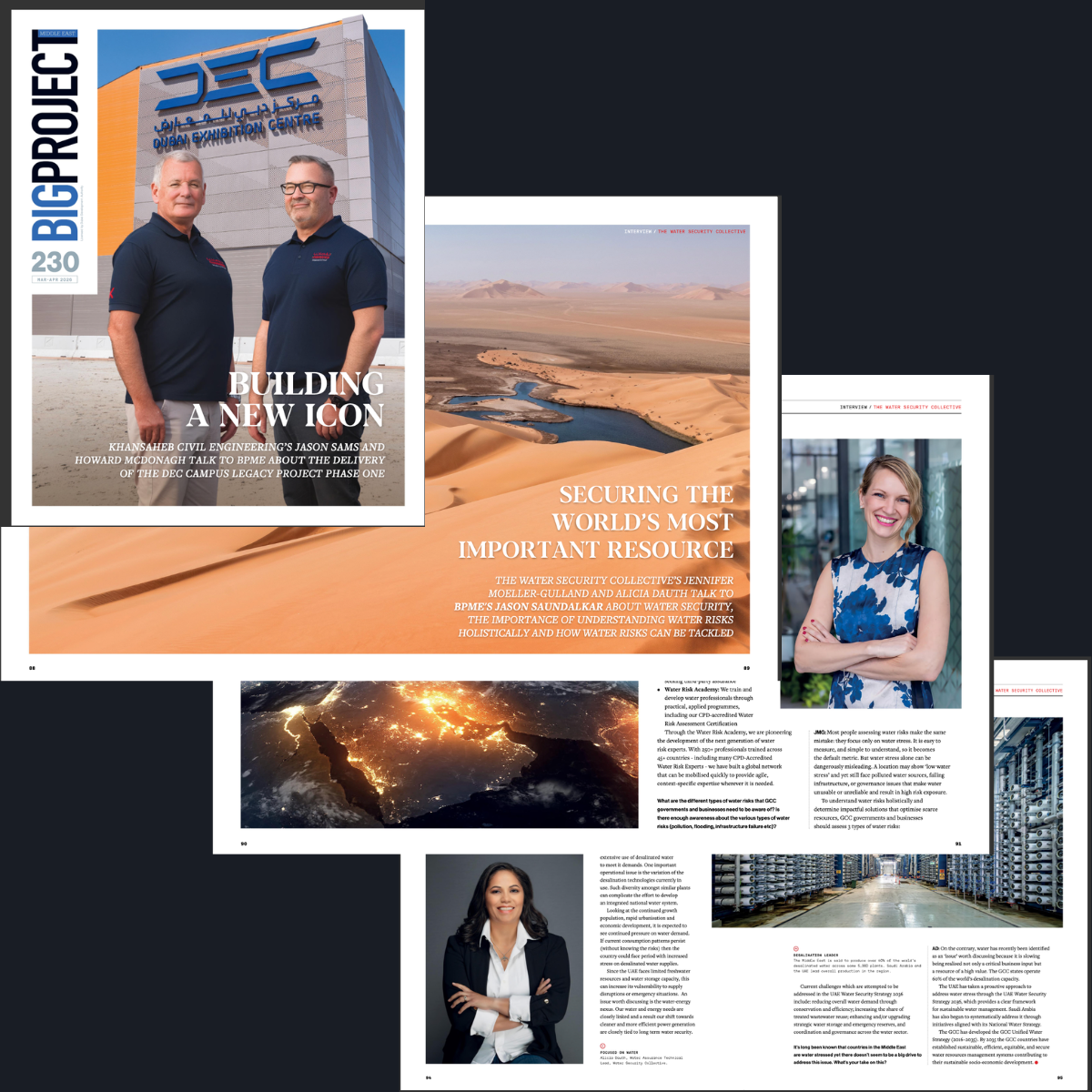
We were honoured to be featured in Big Project Middle East, the region’s leading B2B magazine for the construction and infrastructure industry, to discuss one of the most pressing challenges facing the Gulf region: water security.
In this interview, Water Security Collective Founder & Managing Director Jennifer Moeller-Gulland and Water Assurance Technical Lead Alicia Dauth discuss why water risk assessments need to move beyond water stress alone and how governments and businesses can better understand and manage water-related risks across the GCC.
Looking Beyond Water Stress
One of the central messages of the interview is that organisations often focus only on water stress, because it is relatively easy to measure. However, water stress alone provides only a partial picture.
A location may show low water stress while still experiencing polluted water sources, failing infrastructure or governance challenges that create significant business risk.
To understand water risks holistically, organisations should assess three categories of risk:
- Physical risks – including water stress, pollution of ground and surface water, and water-related disasters such as droughts, floods and landslides.
- Infrastructure risks – including water supply capacity, efficiency and losses (non-revenue water), and wastewater collection and treatment capacity.
- Governance risks – including legal and regulatory frameworks, institutional responsibilities, financing, capacity, transparency and accountability.
Assessing all three categories together helps uncover the real drivers of risk and identify solutions that build resilience.
A Holistic Approach to Water Risk Assessment
In the interview we outline five practical steps for assessing water risks holistically.
1. Use open-source tools for initial screening
Open-source tools are useful for identifying potential hotspots across many sites. However, they should not be used as complete assessments because they cannot accurately capture local realities or support site-level decision making.
2. Conduct an in-depth assessment
Assessments should examine all three water risk categories—physical, infrastructure and governance—at the relevant scale, whether site, city, basin or country.
3. Identify underlying drivers
Understanding why risks exist is essential. Without addressing root causes, investments may be ineffective or even create unintended consequences.
4. Contextualise findings
Water risks should always be interpreted within the local basin and site context. Facilities in the same basin can experience very different levels of risk depending on infrastructure, governance and operational characteristics.
5. Translate findings into targeted action
Recommendations should prioritise measures that reduce risk, strengthen resilience and create strategic opportunities. There is no one-size-fits-all solution; actions must be tailored to local conditions.
Managing Water Risks
Companies can only manage water risks once they understand them.
The first step is to assess water risk exposure across operational sites and, where relevant, throughout the supply chain. This enables organisations to identify the drivers of physical, infrastructure and governance risks and understand the contextual risks at each location.
Once risks have been assessed, organisations should develop water strategies that prioritise high-risk locations and focus on addressing root causes.
Many water challenges also require collective action involving governments, utilities, local industry and community stakeholders, as they cannot be solved by a single organisation acting alone.
To enhance credibility and external verification, companies can also pursue recognised water stewardship certifications such as the Alliance for Water Stewardship (AWS) or SCS-116, helping ensure transparency, best-practice implementation and long-term resilience.
The Biggest Water Challenges Facing the UAE and Saudi Arabia
According to Alicia Dauth, GCC countries have experienced rapid growth in water consumption driven by economic growth, population increases and urbanisation. Consumption rates across the region are currently unsustainable.
Saudi Arabia
Key challenges include:
- Limited availability of accurate and up-to-date water resource data and sustainability indicators.
- Continued reliance on non-renewable groundwater resources.
- Developing public awareness around water conservation.
- Scaling water recycling and restoration initiatives.
- Managing the water-energy nexus.
- Supporting rapid urbanisation while ensuring long-term water security.
United Arab Emirates
Despite extensive desalination capacity, the UAE faces several important challenges:
- Variation in desalination technologies across facilities, making integration more complex.
- Continued growth in water demand driven by population growth and economic development.
- Limited freshwater resources and water storage capacity, increasing vulnerability to supply disruptions.
- Managing the close relationship between water and energy systems.
Current initiatives under the UAE Water Security Strategy 2036 include reducing water demand through conservation and efficiency, increasing treated wastewater reuse, strengthening strategic water storage and emergency reserves, and improving coordination and governance across the sector.
Water Security Is Becoming a Strategic Business Issue
Water has increasingly been recognised as an issue worthy of discussion because it is not only a critical business input but also a valuable resource.
The GCC countries currently operate around 60% of the world’s desalination capacity, and governments across the region have begun implementing ambitious water security strategies. By 2035, the GCC Unified Water Strategy (2016–2035) aims to establish sustainable, efficient, equitable and secure water resource management systems that contribute to long-term socio-economic development.
Why Water Security Collective Was Founded
Water Security Collective was established in 2021 after recognising a critical gap in how water risks were being assessed and acted upon.
Unlike greenhouse gas emissions, where “less is always better”, water is highly contextual. A solution that strengthens resilience in one location can be ineffective—or even harmful—in another. Yet decisions are often made without a deep understanding of local water risks or the underlying drivers, leading to costly and counterproductive outcomes for corporates and governments alike.
To address this challenge, Water Security Collective developed its proprietary Water Risk Assessment Blueprint, drawing on more than 15 years of experience assessing water risks across countries, sectors and contexts. The methodology enables organisations to assess risks accurately at site, city, basin and national level, translating insights into smarter investment decisions, strategic opportunities and long-term resilience.
Our Services
Over the past four years, Water Security Collective has become a trusted partner to corporations and governments seeking to assess, understand and communicate water risks.
Our work focuses on four core areas:
- Strategic Water Risk Assessments – helping organisations assess water risk exposure across operations, value chains, regions and sectors.
- Water Strategy & Stewardship Advisory – supporting the development and implementation of water strategies at site, basin and national level.
- Water Risk Academy – developing water professionals through practical training programmes, including our CPD-accredited Water Risk Assessment Certification.
Since launching the Water Risk Academy, more than 250 professionals across 45+ countries have been trained, creating a global network of water risk experts.
Read the Full Feature
The complete interview was published in Big Project Middle East (March–April 2026 edition, pages 89–95).
If you would like to learn more about Water Security Collective’s work in strategic water risk assessments, water stewardship, assurance or professional training, we’d be delighted to hear from you.
