Water risk screening tools have become the default starting point for organisations trying to understand their exposure to water-related risks.
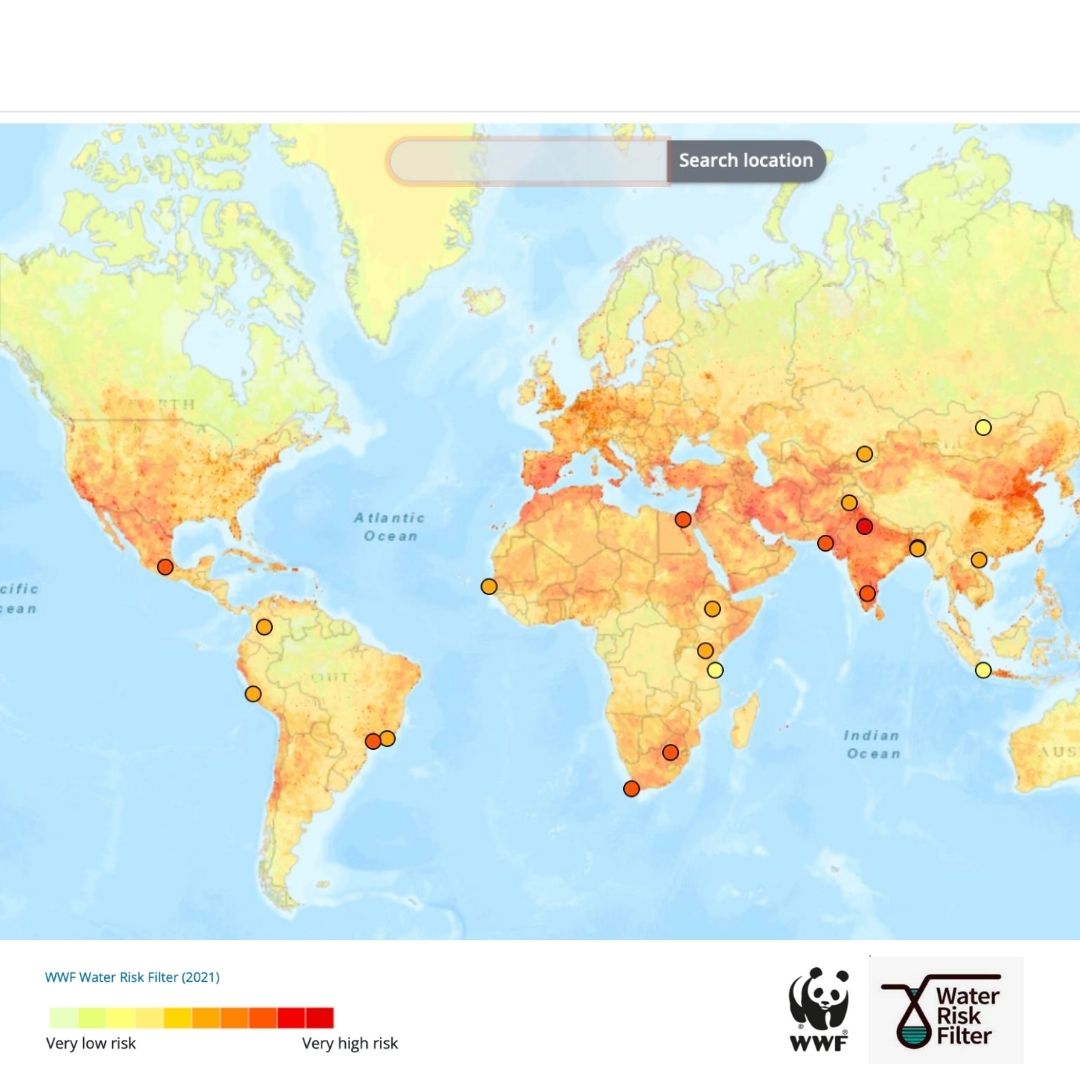
Tools such as the WWF Water Risk Filter and WRI Aqueduct are widely used — and for good reason. They have helped put water risk on the strategic agenda, especially for organisations operating across many geographies.
But while these tools are useful, relying on them alone can create a false sense of confidence and result in decisions that turn out to be costly mistakes, difficult to reverse, and risky in ways that only become visible once operations are already underway.
Based on my project experience, I’ll explain in this article explains what water risk screening tools are good at, where their limits lie, and how to use them properly.
How to Use Water Risk Screening Tools Correctly
Water risk screening tools are built for high-level comparison and prioritisation, not for detailed, site-specific decision-making.
Used well, they help organisations:
- Get a global overview of potential water-related risks
- Compare sites or regions at a portfolio level
- Identify potential hotspot locations
- Start internal conversations about water as a strategic risk
For organisations with large, geographically dispersed operations, screening tools are often the first practical entry point into their water risk journey.
What they are not designed to do is determine actual site-level water risk exposure, explain root causes, or predict how risks will materialise in practice. Their role is to flag where to dive deeper, not to help decide on concrete actions.
Why Water Risk Exposure Is Hard to Assess Through Screening Alone
Water risk behaves differently from many other environmental risks.
Unlike greenhouse gas emissions, water risk is local, contextual, and shaped as much by governance and infrastructure as by hydrology. Two sites can sit within the same river basin, show the same risk score on a global map, and still face very different realities on the ground.
This is where screening tools inevitably reach their limits.
Water Risk Screening Tools: Global Datasets vs. Local Reality
Both WWF Water Risk Filter and WRI Aqueduct rely on global or regional datasets. That is necessary for global comparison — but it comes at cost of local accuracy.
Even though users enter a precise site location, the underlying analysis is typically conducted at a river basin or sub-basin level, using aggregated data. Basin-level insights are important, but they cannot assess the actual water risk expsoure of the site alone.
Within the same sub-basin, conditions can vary dramatically depending on:
- Local water demand and competing users
- Pollution levels and water quality
- Infrastructure performance and access to services
- Land use and urbanisation patterns
An operational site in central Dhaka faces fundamentally different water risks than a site in rural Bangladesh — despite both receiving the same basin-level risk score. When screening tools assign them the same category, these differences disappear from view.
What Water Risk Screening Tools Often Miss on the Supply Side
Many screening tools focus heavily on physical water stress indicators. But several supply-side factors that strongly influence actual water availability are only partially captured — or not captured at all.
These often include:
- Water storage capacity (dams, reservoirs)
- Groundwater depletion beyond model assumptions
- Environmental flow requirements
- Condition and reliability of water infrastructure
- Inter-basin water transfers
- Seasonal mismatches between supply and demand
These factors can completely change real-world water risk exposure. A basin may appear water-secure on paper while exporting large volumes of water elsewhere — or appear highly stressed while storage buffers seasonal shortages.
Without this context, screening results can be misleading.
Proxy Indicators and the Loss of Nuance with Water Risk Screening Tools
Where global data does not exist, screening tools rely on proxy indicators — particularly for governance, regulatory, and reputational risks.
For example, WRI Aqueduct uses WASH access data and country-level ESG risk indices to assess regulatory and reputational risks. While their intent is understandable, this information alone cannot explain how regulations are enforced, how institutions function, or how water conflicts actually play out locally.
Further, to allow for easier interpretation and comparison across regions, only the score is published and not the underlying data. This leads to a loss of nuance. Overall scores make it difficult to understand which specific factors are driving risk, or how sensitive outcomes are to changes in individual variables. The also cannot be used for further analysis, for which in most cases all data is needed (e.g. water demand and supply data vs. a water stress score).
When Screening Tools Drive the Wrong Decisions
The risk of driving wrong decisions doesn’t arise not from the tools themselves, but from how they are used.
Imagine a company screening locations for expansion. One site appears relatively low risk based on global water risk scores. The decision is made to proceed without further investigation.
Once operations begin, challenges emerge:
- Water supply proves unreliable
- Groundwater levels are falling due to weak regulation
- Poor water quality increases operating costs
- Competition with other users intensifies
- Community concerns escalate
Despite favourable screening results, water-related disruptions begin to affect operations, costs, and reputation.
In a recent project, a client asked us to conduct an in-depth water risk assessment for one of their production sites in China, as they were interested in expanding operations. The screening tools categorised the location as medium water stress. However, when we analysed local supply and demand data, the situation was very different.
The city sourced its water from a sub-basin that was already severely water-stressed and unable to meet its own demand. To temporarily close the gap, water was being transferred from an upstream sub-basin. Yet projections showed that this upstream source would itself be unable to meet demand within a few years.
Government planning documents openly acknowledged that no long-term solution had yet been identified to secure water supply for this rapidly growing urban area beyond 2030 — despite some of the strictest water-efficiency and water-saving requirements we have encountered in practice.
Had the company proceeded based solely on screening results, it would have faced significant water-supply reliability risks in the near future, with limited options to mitigate risk once investments were made.
Screening tools can signal where to look, but they cannot determine whether a site is viable – or what water risk exposure it faces. Treating screening outputs as decision-grade insights can expose organisations to risks that only become visible when it is already too late to change course.
Why So Many Organisations Rely on Water Risk Screening Tools Alone
There are understandable reasons why screening tools are often used as decision-making shortcuts:
- Limited internal water-risk expertise
- Pressure to deliver rapid ESG outputs
- Budget and time constraints
- The assumption that water risk equals water stress
- The apparent authority of maps, dashboards, and scores
For many teams, screening tools offer a practical and accessible solution — especially when deeper assessments appear complicated or resource-intensive and guidance on how to approach a proper water risk assessment is missing.
Reliance on screening alone often reflects a capability gap, rather than a lack of intent to do it correctly.
Will Better Data and AI Solve This in Future?
Advances in satellite data, remote sensing, big data analytics, and artificial intelligence are rapidly improving the quality of water-related information available globally. Over time, these developments may enhance the ability of screening tools to reflect local conditions more accurately.
Yet even with improved data, certain dimensions of water risk remain difficult to capture remotely — particularly governance effectiveness, institutional capacity, infrastructure management, and informal water use.
Data alone cannot (yet) replace contextual understanding.
What Water Risk Screening Tools Cannot Replace
Effective water risk assessment requires looking beyond water stress alone. In practice, water risks emerge from the interaction of three dimensions:
Physical risks
Water stress, water quality, floods, and droughts
Infrastructure risks
Storage, water treatment and distribution, wastewater collection and treatment, and overall system reliability
Governance risks
Laws and regulation, enforcement, institutional set up and coordination of stakeholders, capacity, finance, impact of corruption etc
Looking at these dimensions together reveals not just where risks exist, but why they exist and how they are likely to evolve.
Read more about why water stress alone is not sufficient to assess water risks here.
Same Water Stress, Very Different Outcomes
A useful illustration of these dynamics can be seen by comparing Singapore and Karachi. Based on the water risk tools, both locations show similar levels of water stress.
In practice, their outcomes could not be more different.
Singapore has invested heavily in infrastructure, diversified supply sources, long-term planning, and strong governance. Karachi faces challenges related to infrastructure performance, institutional coordination, and enforcement — resulting in unreliable supply, pollution, and severe flood impacts.
The risk does not lie in water stress alone, but in how water systems are managed.
In the case of Singapore and Karachi, most of us can catch that something is off when we see similar risk ratings from the water risk screening tools. However, it gets a lot more complicated to spot when your assessments inlcudes sites you don’t know and have never been to. Costly – and embarrassing – errors can sneak in very quickly.
Using Water Risk Screening Tools the Right Way
Water risk screening tools are most valuable when they are used to:
- Identify potential hotspots
- Prioritise sites for deeper assessment
- Support internal discussions about exposure
- Allocate resources for further investigation
They should not be used as standalone decision-making tools or as substitutes for in-depth water risk assessments.
They are a starting point — not an endpoint.
Final Thought
As water risks increasingly affect business continuity, investment decisions, and supply chains, only partial understanding of water risk exposure is a risk in itself.
For organisations, moving beyond screening tools – and completing a proper water risk assessment – can prevent costly mistakes.
For professionals, this shift creates a growing need for capabilities that go beyond applying water risk screening tools and interpreting indices. Understanding how physical water risks interact with infrastructure performance and governance systems is becoming essential for informed decision-making.
If you want to deepen your understanding of how to assess, communicate and mitigate water risks — this is exactly what we explore in our newsletter and Water Risk Training programmes.
Subscribe to the Water Risk Newsletter to receive practical insights, case examples, and tools used in real-world water risk assessments.
And one more thing
If you’ve heard colleagues, clients, or partners say they are “covered” because they ran their sites through a water risk tool, please share this article with them. Screening tools are valuable — but using them as a substitute for proper assessment can lead to decisions that are difficult and costly to reverse and these resources can surely be used better.